FIRST AID/CPR AED TRAINING
On-site training, so your staff have the skills & confidence to respond safely in an emergency.
Canadian Red Cross Certified. CSA Standard Z1210-17 First Aid Training for the workplace
What we do
Debco Safety is a Canadian Red Cross Training Partner. We offer Alberta Workplace approved First Aid & CPR Courses that meet OHS guidelines and include CSA Standard Z1210-17 First Aid Training for the workplace.
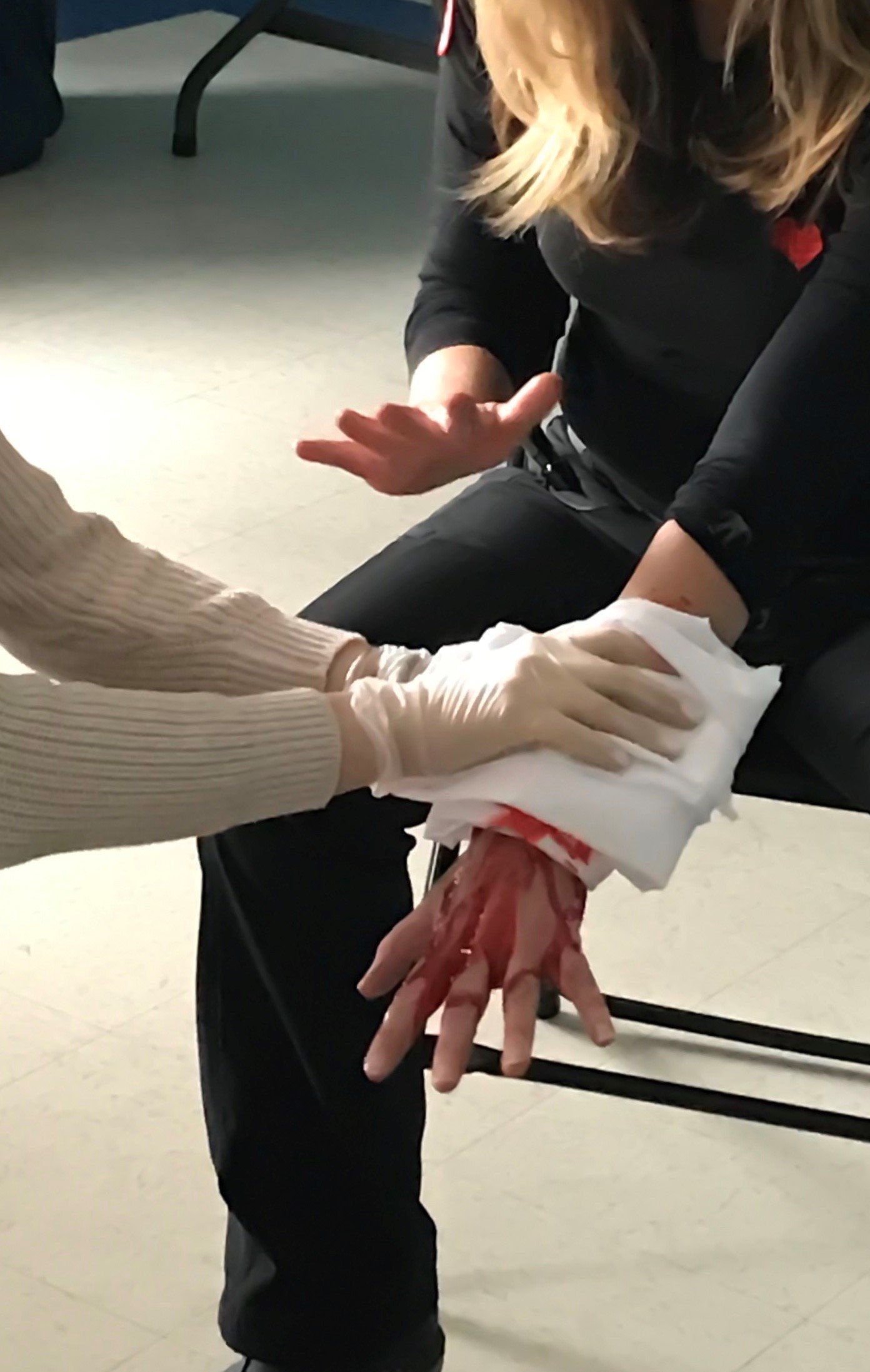
With years as a business professional, I understand how important time management is. Our courses are unique, with real life scenario practice, keeping everyone engaged in the training.
Debco provides a customized agenda that meets your specific company needs. We provide all the training supplies and PPE for every course. We set up, clean up, and take care of all the details.

How it all began…
I can trace my career aspirations back to my early years in the suburbs of Toronto, where I grew up for most of my young life.
Hearing that ambulance go by, I wanted to be a part of helping sick people get better and respond in life’s most critical moments. I wanted to be a Paramedic.
In loving memory of Shelby. Forever in our Hearts
Why work with Debco Safety?
On-site training is cost effective, allows greater flexibility for group certifications and provides a great team building activity!
Debco Safety is a certified Canadian Red Cross Training Partner.
First Aid & CPR Courses
Our certified First Aid Training for the workplace, meets CSA Standard Z1210-17, OHS regulations and includes the latest CPR guidelines. Our goal is to ensure participants are equipped with the skills and confidence to respond safely to an emergency.
Online Health & Safety Courses
The term “lockout/tagout” refers to specific practices and procedures to safeguard workers from the unexpected energizing or start-up of machinery and equipment, or the release of hazardous energy during service or maintenance activities. Lockout/Tagout explains the importance of lockout/tagout in protecting the health and safety of workers.
Duration: 1.5–3 hours online
The term “lockout/tagout” refers to specific practices and procedures to safeguard workers from the unexpected energizing or start-up of machinery and equipment, or the release of hazardous energy during service or maintenance activities. Lockout/Tagout explains the importance of lockout/tagout in protecting the health and safety of workers.
Employers should train ALL workers in the basic concepts of hazardous energy control, including energy isolation, locking and tagging of control devices, verifying de-energization, and clearing danger points before re-energizing equipment. Workers whose duties involve installation, maintenance, service, or repair work should be trained in the detailed control procedures required for their particular equipment. This training should enable workers to identify tasks that might expose them to hazardous energy and the effective methods for its control.
Completion: At the end of each module, there is a test. Participants must successfully complete the test before continuing to the next module. Participants that do not achieve 100% can review the module content and try as many times as necessary to advance and complete the course.
Certification: Upon successfully completing all modules, there is a printable certificate for your records.
This course is non-refundable.
Hydrogen Sulphide (H2S) is a highly toxic and flammable gas. Each year in Canada, workers are injured and killed by exposure to H2S. H2S Awareness explains the properties of H2S, identifies control measures, and provides a practical description of what to do in the event of exposure.
Duration: 1 hour online
Hydrogen Sulphide (H2S) is a highly toxic and flammable gas. Each year in Canada, workers are injured and killed by exposure to H2S. H2S Awareness explains the properties of H2S, identifies control measures, and provides a practical description of what to do in the event of exposure.
The risk of H2S exposure exists in many industries, including, but not limited to oil and gas, pulp and paper, construction, and mining. In workplaces where the possibility of H2S exposure exists, ALL workers should have H2S Awareness training. Workers who are at risk of exposure to H2S and/or workers with rescue responsibilities also require H2S Alive and workplace-specific training.
Completion: At the end of the module, there is a multiple-choice test. Participants must successfully complete the test in order to continue to complete the course. Participants that do not achieve 100% can review the module content and re-test.
Certification: Upon successful completion of the course, participants can download/print a certificate of completion.
Important Note: Once your selected course has been purchased, an online access code will be sent during normal BUSINESS HOURS. (Monday – Friday 8am – 5pm) Registrations submitted on the weekend, will be processed the following business day.
Fire Safety teaches participants about the legislated fire safety responsibilities of the employer and the worker, describes safe work practices related to fire prevention, and provides practical information about emergency response in situations involving fire.
Duration: 1–2 hours online
Fire Safety teaches participants about the legislated fire safety responsibilities of the employer and the worker, describes safe work practices related to fire prevention, and provides practical information about emergency response in situations involving fire.
This course is appropriate for all workplace parties, including frontline workers, supervisors, and management. Everyone in the workplace needs to understand the principles of fire safety and how to respond effectively in the event of a fire.
Completion: Fire Safety is a 4-module course. At the end of each module, there is a test. Participants must successfully complete the test in order to continue to the next module. Participants that do not achieve 100% can review the module content and re-test. There is no limit on the number of times a participant can attempt testing.
Certification: Upon successful completion of all modules, participants can download/print a certificate of completion.
This course is non-refundable.
When there is a confined space in the workplace, all workers in that workplace require Confined Space Awareness training as well as workplace-specific training.
This online course identifies the characteristics of a confined space, describes the risks associated with working in a confined space and the prescribed methods for controlling those risks, and explains the documentation requirements pertaining to confined space work.
Duration: 2–3 hours online
When there is a confined space in the workplace, all workers in that workplace require Confined Space Awareness training as well as workplace-specific training.
This online course identifies the characteristics of a confined space, describes the risks associated with working in a confined space and the prescribed methods for controlling those risks, and explains the documentation requirements pertaining to confined space work.
This course should be provided to all workers in a workplace that contains a confined space. It meets the requirement for Awareness Level training.
Note: Successful completion of Confined Space Awareness Training DOES NOT reduce or negate the need for workplace-specific training, as provided by the employer.
Completion: At the end of each module, there is a test. Participants must successfully complete the test before continuing to the next module. Participants that do not achieve 100% can review the contents of that module and can re-take the test as many times as necessary to complete the course.
Certification: Upon successfully completing all modules, there is a printable certificate of completion for your records.
Important Note: Once your selected course has been purchased, an online access code will be sent during normal BUSINESS HOURS. (Monday – Friday 8am – 5pm) Registrations submitted on the weekend, will be processed the following business day.
Bears are fascinating creatures that are generally quite peaceful, but they are also powerful carnivores capable of doing great damage to property as well as human beings and should be treated with respect. This course covers general bear facts as well as discussing safety procedures for personnel working in the field, and the proper procedures for setting up and maintaining a safe camp.
This course is designed for anyone working in bear country.
Duration: 2–3 hours online
Bears are fascinating creatures that are generally quite peaceful, but they are also powerful carnivores capable of doing great damage to property as well as human beings and should be treated with respect. This course covers general bear facts as well as discussing safety procedures for personnel working in the field, and the proper procedures for setting up and maintaining a safe camp.
This course is designed for anyone working in bear country.
Completion: At the end of each module, there is a test. Participants must successfully complete the test before continuing to the next module. Participants that do not achieve 100% can review the module content and try as many times as necessary to advance and complete the course.
Certification: Upon successfully completing all modules, there is a printable certificate for your records.
Important Note: Once your selected course has been purchased, an online access code will be sent during normal BUSINESS HOURS. (Monday – Friday 8am – 5pm) Registrations submitted on the weekend, will be processed the following business day.
This course is non-refundable.
The best way to minimize an encounter with a bear is by practicing prevention. Don’t wait until you are head-to-head with a bear to think about what you could have done to avoid an encounter. Bear Aware: Travelling in Bear Country provides general knowledge about bears, their habits, and behaviours. It will also discuss some ways to help prevent bear encounters, as well as what you need to do to increase your chances of survival should a bear encounter or attack happen.
Duration: 1–2 hours online
The best way to minimize an encounter with a bear is by practicing prevention. Don’t wait until you are head-to-head with a bear to think about what you could have done to avoid an encounter. Bear Aware: Travelling in Bear Country provides general knowledge about bears, their habits, and behaviours. It will also discuss some ways to help prevent bear encounters, as well as what you need to do to increase your chances of survival should a bear encounter or attack happen.
This course is designed for anyone travelling or camping through bear country.
Completion: At the end of the module, there is a test. Participants that do not achieve 100% can review the module content and try as many times as necessary to complete the course.
Certification: Upon successfully completing the module, there is a printable certificate for your records.
This course is non-refundable.
WHAT’S BEEN SAID
The online Canadian Red Cross First Aid for Dogs and Cats course, teaches you how to respond to common emergencies involving cats and dogs. This course overs essential skills like dog CPR (cardiopulmonary resuscitation), cat first aid, and pet emergency care. Learn how to be prepared for any emergency and obtain a pet first aid certification. Enroll now to protect your furry friends with confidence.
What will you learn?
How to handle common dog and cat emergencies confidently.
Skills to perform dog first aid and cat first aid.
Learn to identify normal vital signs and perform CPR for dogs and cats.
Learn how to manage wounds, respond to seizures, and support overall dog and cat health and well-being.
Who should take the First Aid for Dogs and Cats course?
Pet owners and anyone interested in becoming a dog sitter or a cat sitter.
Anyone 13 years of age and older. This course has no prerequisites.
Canadian Red Cross Online-Based Learning
Self-directed: Learn at your own pace by working through the training materials online.
Duration: Approximately 1 hour online
At the end of each module, there will be a short knowledge check. These are not tests; you are not being evaluated. They are just there so you can check your own understanding of what has been covered so far. Remember, you can always go back and review if you wish.
Boost your resume with a certification
Successfully completing the Canadian Red Cross pet first aid course will earn you certificate of completion.
First Aid for Dogs and Cats Modules
Module 1: Knowing What's Normal
In Module 1, we will discuss recognizing normal vital signs for our furry friends. This module helps you understand what is normal for your pet so you can recognize any unusual signs. We will cover the fundamental aspects of checking your pet's vital signs, allowing you to detect any changes quickly.
You will learn about dogs' and cats' breathing rates, signs of dehydration, body temperature, heart rate, and pulse. Also, how to check their heartbeat and pulse and check their mucous membranes.
Module 2: Breathing and Cardiac Emergencies
In this lesson, we will learn about breathing and cardiac emergencies for pets. Knowing how to respond quickly in such situations is important, as they can be life-threatening.
By the end of this lesson, you will be able to check your pets' airway, breathing, and circulation. You will also learn how to perform CPR on your cat or dog. You will learn the skills to figure out if your pet is choking and the necessary steps to help them.
We will cover ABC's, cat and dog CPR, how to do CPR on a dog or a cat and treating choking. These skills are crucial in ensuring the safety and well-being of our furry friends in times of emergency.
Module 3: Wounds and Bleeding
In Module 3 of the pet first aid training, we will learn about wounds and bleeding. Understanding that different types of wounds can lead to other complications and require different care is important. Learn about different types of wounds your pet may have so you can be ready to give them the care they need.
In this lesson, we will learn about different types of injuries that can happen to our pets. These include abrasions, bite wounds, lacerations, and pad wounds.
We will also learn how to help our pets when they experience these injuries. After this lesson, you will know how to care for wounds and control bleeding on your pet.
Module 4: Seizures
In Module 4 of the First Aid for Dogs and Cats course, you will learn all about seizures in pets. This lesson is important because it teaches you how to help your pet if they ever have a seizure. Even though it can be scary, knowing what to do to keep your pet safe is essential.
The lesson will cover what causes seizures, what they look like, and how to help your pet during and after a seizure. You will also learn when it's necessary to take your pet to the vet. At the end of this lesson, you will know how to recognize seizures in your pet and understand what seizures are and how to help, your pet should your pet have one.
Module 5: Preventative Care, Health, and Well-being
In Module 5, we will learn about preventative care, health, and well-being for our pets. In this lesson, we will learn how to take care of our pets and keep them healthy to prevent sickness. We will also discuss the importance of preparing for emergencies. By following a few simple steps, we can ensure that our pets live happy, healthy lives full of love and fun!